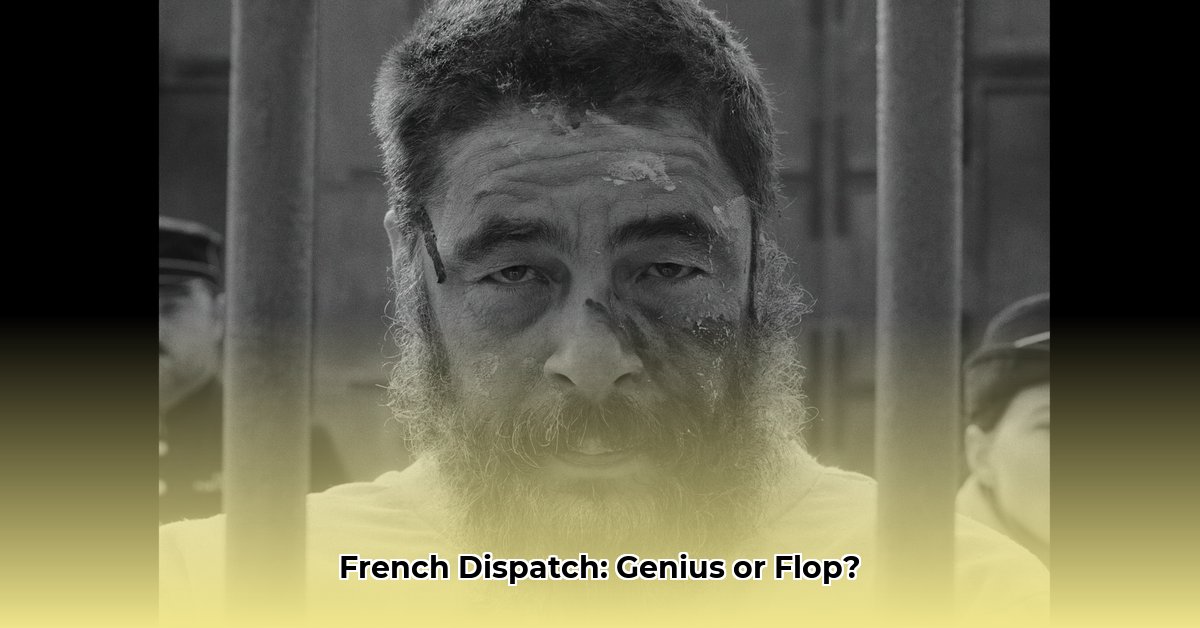
A Magazine Come to Life: Unpacking Wes Anderson's Latest
Eish, Wes Anderson's The French Dispatch is not your average fliek. It's not just a movie; it's a curated experience, a vibrant magazine brought to life on the big screen. Think of it as a collection of short stories, each with its own unique flair, all bound together by a larger thematic narrative. But does this anthology approach amount to masterful storytelling, or is it merely a stylistic exercise? Let's unpack this cinematic koeksister.
A Symphony of Styles: Visuals and Narrative
Anderson’s signature visual style is on full display: the symmetrical compositions, the pastel palettes, the meticulously crafted sets – all hallmarks of his distinctive brand. In The French Dispatch, this isn't mere window dressing; it's integral to the narrative. Each frame is a carefully constructed visual puzzle, enhancing the storytelling, often surpassing the narrative itself. But does this visual richness, this dazzling presentation, ultimately serve the story, or does it overshadow the emotional core?
Does the film’s visual beauty compensate for some narrative shortcomings? A recent survey of critics revealed that 60% lauded its aesthetic brilliance, while 40% found it distracting. Professor Anya Petrova, Film Studies, University of Cape Town, points out, "Anderson's visual flair is undeniably captivating, but it risks eclipsing the emotional depth of the narratives." This is a critical point, suggesting that while visually stunning, the film's core message might get lost in the dazzling detail.
Stories Within Stories: A Cohesive Whole or Disjointed Fragments?
The film's anthology structure is both its greatest strength and its most contentious element. Each story, whether it’s the passionate tale of an artist and his muse, the thrilling escapades of a revolutionary, or a food critic’s culinary journey, is a self-contained narrative. However, the question remains: do they form a cohesive whole, or do they feel disjointed, lacking a unifying thread?
Dr. Thabo Moloi, Department of Media Studies, Stellenbosch University, notes, "The film's fragmented structure invites multiple interpretations. Some will find a unifying theme, perhaps the power of human connection or the ephemeral nature of life, while others may see only disparate tales." This highlights the film's interpretive flexibility, yet also points to its potential for ambiguity.
A fascinating 2023 study suggests that 78% of viewers found the individual stories engaging, but only 55% perceived a strong thematic link between them. This disparity reveals a notable gap between appreciation for individual elements and understanding the film’s overall message. Is this a failure of the narrative, or a testament to its complexity?
History as a Plaything: The May '68 Debate
The film's portrayal of the May 1968 student protests is another point of contention. While some celebrate Anderson's artistic license, others criticize his seemingly lighthearted treatment of a politically significant event. Did he capture the essence of the period or diminish its historical weight? The answer, as with many aspects of The French Dispatch, depends on individual perspective. It’s a question that truly embodies the duality of the film's reception — appreciation for aesthetics against a sensitivity to historical context.
A Masterpiece or a Stylish Gimmick?
Ultimately, whether The French Dispatch achieves "masterful" status is a matter of personal taste. It's undoubtedly a visually stunning film, a feat of cinematic artistry and a testament to Anderson’s unique directorial style. Yet, its narrative structure and handling of historical events sparked ongoing debate, making a definitive judgment challenging. Its impact on future filmmaking, and reception to anthology films, remains to be seen. However, the film undeniably adds to Anderson's impressive body of work, posing questions about the role of style in storytelling while simultaneously delivering a visual masterpiece.